2026
General Dentistry is AGD's peer-reviewed journal. Published bimonthly, General Dentistry presents research and clinical findings to support the full range of procedures that general dentists perform on a regular basis.
2025
2024
2023
2022
2021
2020
2019
2018
2017
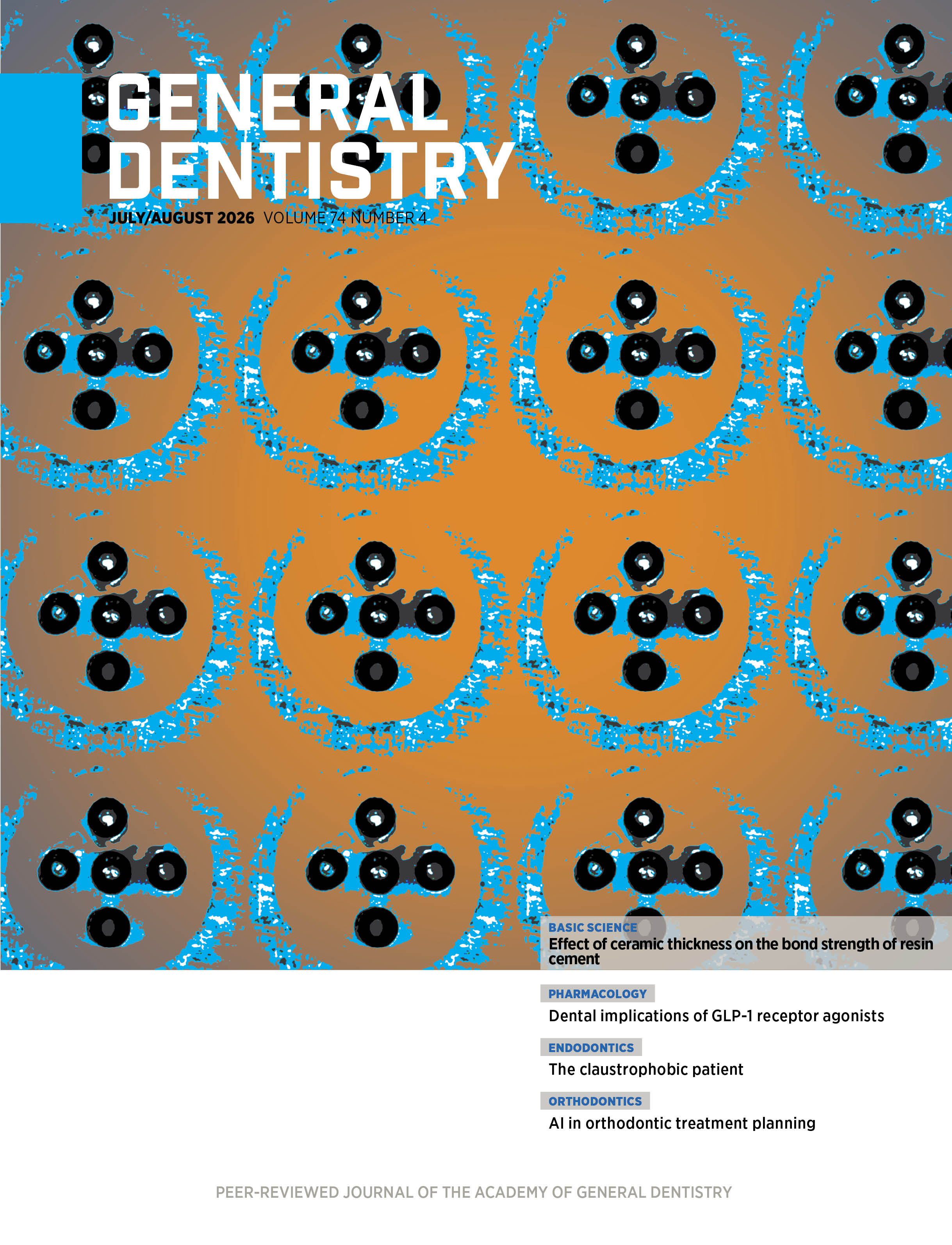
July/August 2026
Table of Contents
Departments
-
Editorial Change is ubiquitous
Full Article (PDF)Timothy F. Kosinski2026 July/August; 74(4):6.
-
Public Health Prescribe with purpose: why antibiotic stewardship belongs in every dental practice
Full Article (PDF)McAllister Castelaz2026 July/August; 74(4):7-9.
-
Endodontics The claustrophobic patient
Full Article (PDF)Nathan Dinsbach2026 July/August; 74(4):10-12.
-
Pharmacology The oral-systemic frontier: navigating the dental implications of GLP-1 receptor agonists
Full Article (PDF)Mark DonaldsonJason H. Goodchild2026 July/August; 74(4):13-17.
-
Trending Topics in Dentistry Recent clinical updates and new classifications
Full Article (PDF)John K. BrooksNasir Bashirelahi2026 July/August; 74(4):18-20.
-
Oral Diagnosis Calcified antral mass and Circumscribed periapical radiolucency
Full Article (PDF)Galal Omami2026 July/August; 74(4):78,80.
-
Self-Instruction Answers Exercises No. GD548 and GD549
Full Article (PDF)2026 July/August; 74(4):79.
Clinical Articles
-
Basic Science Influence of the thickness of high-translucency ceramics on the bond strength of a universal resin cement following different storage times
Full Article (PDF)Cristiano Pires e SilvaOdirlei Arruda MalaspinaRoberta Tarkany BastingThis study examined the effect of the thickness of ultratranslucent lithium disilicate and third-generation zirconia ceramic discs (0.5 vs 1.5 mm) on the bond strength of resin cement following 24 hours and 6 months of water storage. Thicker zirconia discs showed the highest bond strength. Although the bond strength of zirconia decreased over time, 1.5-mm discs still showed greater strength than 1.5-mm lithium disilicate discs at 6 months. The values for lithium disilicate were stable.2026 July/August; 74(4):70-76.
-
SELF-INSTRUCTION
Restorative Dentistry Effect of immediate vs delayed polishing on the surface roughness of microhybrid and nanohybrid composite resins
Full Article (PDF)Geetika PableSuparna G. SahaMainak K. SahaRolly AgarwalManasi KewlaniAffrin ShaikhAn in vitro experiment assessed the effect of polishing protocols on the surface roughness of microhybrid and nanohybrid composite resins. For both materials, delayed polishing following 24-hour immersion in distilled water significantly reduced the surface roughness compared with immediate polishing, but nanohybrid specimens showed superior smoothness with both protocols.2026 July/August; 74(4):65-68.
Self-Instruction Exercise No. GD566 -
Orthodontics Application of orthodontic elastics for the treatment of midline diastemas
Full Article (PDF)Rahul KulkarniHarshit AgarwalRakeshkumar KonthamThis article illustrates an alternative technique for closure of small diastemas (2 mm or less) by applying orthodontic elastics directly on the central incisors without the use of esthetic buttons or removable trays. Once the desired space closure is achieved, the corrected position of the incisors can be retained with a resin-bonded splint to counter labial tipping movement and aid in root alignment.2026 July/August; 74(4):61-64.
-
Orthodontics Guided eruption of an impacted maxillary right canine: a multidisciplinary case report
Full Article (PDF)Marina MirzabekianNarine ArutiunianMaxillary canine impaction is a relatively common eruption disturbance that can compromise smile esthetics and functional occlusion. A case report describes an interdisciplinary approach to treating a palatally impacted maxillary canine in a 16-year-old girl, highlighting space creation, conservative palatal exposure, controlled orthodontic traction, and radiographic surveillance throughout active eruption.2026 July/August; 74(4):56-60.
-
Oral Medicine, Oral Diagnosis, Oral Pathology Giant compound odontoma associated with a severely displaced mandibular canine: a case report
Full Article (PDF)John K. BrooksElvia D. Jimenez CiriacoSara D. MeadeAzin ParsaAhmed S. SultanJeffery B. PriceRafael F. Casasola-BarriosChristina L. PlatiaAbdullah HanfeshJoshua E. LubekClinical, radiographic, surgical, and histopathologic images document a case of a compound odontoma arising in the mandibular anterior region. The lesion was easily enucleated, and the surgical specimen exhibited numerous tooth-like structures. Radiographic imaging at the 6-month follow-up demonstrated evidence of osseous regeneration of the surgical site.2026 July/August; 74(4):49-54.
-
Orthodontics Access to orthodontic services for pediatric and Medicaid-enrolled populations: a survey of non-orthodontists
Full Article (PDF)Natalia Vazquez MarreroOscar ArevaloCarolina DuarteLesbia B. DrukteinisA survey examined the demographics, practice characteristics, service mix, and barriers faced by non-orthodontists in the provision of orthodontic care to the pediatric population, including children enrolled in Medicaid programs. Respondents reported multiple challenges, particularly for the Medicaid population, underscoring the need for reforms to address financial and administrative barriers to orthodontic care.2026 July/August; 74(4):40-48.
-
SELF-INSTRUCTION
Endodontics Evaluation of the push-out bond strength of fiber posts in canals treated with conventional or ultrasonic preparation protocols
Full Article (PDF)Lorena de Mello Alcântara GarridoMarco Antônio Húngaro DuarteMilena Perraro MartinsÍndia Olinto de Azevedo QueirozAna Grasiela LimoeiroClovis Monteiro BramanteThis in vitro study aimed to compare the effects of conventional and ultrasonic root canal preparation on the adhesion of glass fiber posts to dentin. In push-out testing, the conventional group exhibited significantly lower bond strengths than the ultrasonic group across all anatomical thirds (cervical, middle, and apical). The groups showed no significant differences in failure modes.2026 July/August; 74(4):34-38.
Self-Instruction Exercise No. GD565 -
SELF-INSTRUCTION
Orthodontics What every dentist needs to know about the use of artificial intelligence in orthodontic treatment planning
Full Article (PDF)Michael L. AbromovageMonica P. SchneiderJeffery B. PriceJohn K. BrooksNasir BashirelahiThis review summarizes the advantages and disadvantages of AI systems in orthodontic treatment planning. AI can perform automated functions, allowing clinicians to more effectively use their time making critical diagnostic, treatment, and care decisions. However, clinicians must be aware of the limitations of AI, including ethnic biases in algorithms or datasets and possible ethical challenges.2026 July/August; 74(4):28-32.
Self-Instruction Exercise No. GD564 -
SELF-INSTRUCTION
Orthodontics Assessing the perceived need for maxillary expansion: a survey of general dentists, pediatric dentists, and orthodontists
Full Article (PDF)Carolyn GriffinQingzhao YuNubaira RizviRichard W. BallardPaul C. ArmbrusterA survey with different case scenarios was designed to assess differences among general dentists, pediatric dentists, and orthodontists in perceived treatment need for transverse maxillary expansion. The findings suggest that specialty training strongly influences decisions, highlighting a need for enhanced orthodontic diagnostic education to promote consistency in the diagnosis and management of transverse discrepancies.2026 July/August; 74(4):21-26.
Self-Instruction Exercise No. GD563
2016
July/August 2026
Table of Contents
Departments
-
Editorial Change is ubiquitous
Full Article (PDF)Timothy F. Kosinski2026 July/August; 74(4):6.
-
Public Health Prescribe with purpose: why antibiotic stewardship belongs in every dental practice
Full Article (PDF)McAllister Castelaz2026 July/August; 74(4):7-9.
-
Endodontics The claustrophobic patient
Full Article (PDF)Nathan Dinsbach2026 July/August; 74(4):10-12.
-
Pharmacology The oral-systemic frontier: navigating the dental implications of GLP-1 receptor agonists
Full Article (PDF)Mark DonaldsonJason H. Goodchild2026 July/August; 74(4):13-17.
-
Trending Topics in Dentistry Recent clinical updates and new classifications
Full Article (PDF)John K. BrooksNasir Bashirelahi2026 July/August; 74(4):18-20.
-
Oral Diagnosis Calcified antral mass and Circumscribed periapical radiolucency
Full Article (PDF)Galal Omami2026 July/August; 74(4):78,80.
-
Self-Instruction Answers Exercises No. GD548 and GD549
Full Article (PDF)2026 July/August; 74(4):79.
Clinical Articles
-
Basic Science Influence of the thickness of high-translucency ceramics on the bond strength of a universal resin cement following different storage times
Full Article (PDF)Cristiano Pires e SilvaOdirlei Arruda MalaspinaRoberta Tarkany BastingThis study examined the effect of the thickness of ultratranslucent lithium disilicate and third-generation zirconia ceramic discs (0.5 vs 1.5 mm) on the bond strength of resin cement following 24 hours and 6 months of water storage. Thicker zirconia discs showed the highest bond strength. Although the bond strength of zirconia decreased over time, 1.5-mm discs still showed greater strength than 1.5-mm lithium disilicate discs at 6 months. The values for lithium disilicate were stable.2026 July/August; 74(4):70-76.
-
SELF-INSTRUCTION
Restorative Dentistry Effect of immediate vs delayed polishing on the surface roughness of microhybrid and nanohybrid composite resins
Full Article (PDF)Geetika PableSuparna G. SahaMainak K. SahaRolly AgarwalManasi KewlaniAffrin ShaikhAn in vitro experiment assessed the effect of polishing protocols on the surface roughness of microhybrid and nanohybrid composite resins. For both materials, delayed polishing following 24-hour immersion in distilled water significantly reduced the surface roughness compared with immediate polishing, but nanohybrid specimens showed superior smoothness with both protocols.2026 July/August; 74(4):65-68.
Self-Instruction Exercise No. GD566 -
Orthodontics Application of orthodontic elastics for the treatment of midline diastemas
Full Article (PDF)Rahul KulkarniHarshit AgarwalRakeshkumar KonthamThis article illustrates an alternative technique for closure of small diastemas (2 mm or less) by applying orthodontic elastics directly on the central incisors without the use of esthetic buttons or removable trays. Once the desired space closure is achieved, the corrected position of the incisors can be retained with a resin-bonded splint to counter labial tipping movement and aid in root alignment.2026 July/August; 74(4):61-64.
-
Orthodontics Guided eruption of an impacted maxillary right canine: a multidisciplinary case report
Full Article (PDF)Marina MirzabekianNarine ArutiunianMaxillary canine impaction is a relatively common eruption disturbance that can compromise smile esthetics and functional occlusion. A case report describes an interdisciplinary approach to treating a palatally impacted maxillary canine in a 16-year-old girl, highlighting space creation, conservative palatal exposure, controlled orthodontic traction, and radiographic surveillance throughout active eruption.2026 July/August; 74(4):56-60.
-
Oral Medicine, Oral Diagnosis, Oral Pathology Giant compound odontoma associated with a severely displaced mandibular canine: a case report
Full Article (PDF)John K. BrooksElvia D. Jimenez CiriacoSara D. MeadeAzin ParsaAhmed S. SultanJeffery B. PriceRafael F. Casasola-BarriosChristina L. PlatiaAbdullah HanfeshJoshua E. LubekClinical, radiographic, surgical, and histopathologic images document a case of a compound odontoma arising in the mandibular anterior region. The lesion was easily enucleated, and the surgical specimen exhibited numerous tooth-like structures. Radiographic imaging at the 6-month follow-up demonstrated evidence of osseous regeneration of the surgical site.2026 July/August; 74(4):49-54.
-
Orthodontics Access to orthodontic services for pediatric and Medicaid-enrolled populations: a survey of non-orthodontists
Full Article (PDF)Natalia Vazquez MarreroOscar ArevaloCarolina DuarteLesbia B. DrukteinisA survey examined the demographics, practice characteristics, service mix, and barriers faced by non-orthodontists in the provision of orthodontic care to the pediatric population, including children enrolled in Medicaid programs. Respondents reported multiple challenges, particularly for the Medicaid population, underscoring the need for reforms to address financial and administrative barriers to orthodontic care.2026 July/August; 74(4):40-48.
-
SELF-INSTRUCTION
Endodontics Evaluation of the push-out bond strength of fiber posts in canals treated with conventional or ultrasonic preparation protocols
Full Article (PDF)Lorena de Mello Alcântara GarridoMarco Antônio Húngaro DuarteMilena Perraro MartinsÍndia Olinto de Azevedo QueirozAna Grasiela LimoeiroClovis Monteiro BramanteThis in vitro study aimed to compare the effects of conventional and ultrasonic root canal preparation on the adhesion of glass fiber posts to dentin. In push-out testing, the conventional group exhibited significantly lower bond strengths than the ultrasonic group across all anatomical thirds (cervical, middle, and apical). The groups showed no significant differences in failure modes.2026 July/August; 74(4):34-38.
Self-Instruction Exercise No. GD565 -
SELF-INSTRUCTION
Orthodontics What every dentist needs to know about the use of artificial intelligence in orthodontic treatment planning
Full Article (PDF)Michael L. AbromovageMonica P. SchneiderJeffery B. PriceJohn K. BrooksNasir BashirelahiThis review summarizes the advantages and disadvantages of AI systems in orthodontic treatment planning. AI can perform automated functions, allowing clinicians to more effectively use their time making critical diagnostic, treatment, and care decisions. However, clinicians must be aware of the limitations of AI, including ethnic biases in algorithms or datasets and possible ethical challenges.2026 July/August; 74(4):28-32.
Self-Instruction Exercise No. GD564 -
SELF-INSTRUCTION
Orthodontics Assessing the perceived need for maxillary expansion: a survey of general dentists, pediatric dentists, and orthodontists
Full Article (PDF)Carolyn GriffinQingzhao YuNubaira RizviRichard W. BallardPaul C. ArmbrusterA survey with different case scenarios was designed to assess differences among general dentists, pediatric dentists, and orthodontists in perceived treatment need for transverse maxillary expansion. The findings suggest that specialty training strongly influences decisions, highlighting a need for enhanced orthodontic diagnostic education to promote consistency in the diagnosis and management of transverse discrepancies.2026 July/August; 74(4):21-26.
Self-Instruction Exercise No. GD563
2015
July/August 2026
Table of Contents
Departments
-
Editorial Change is ubiquitous
Full Article (PDF)Timothy F. Kosinski2026 July/August; 74(4):6.
-
Public Health Prescribe with purpose: why antibiotic stewardship belongs in every dental practice
Full Article (PDF)McAllister Castelaz2026 July/August; 74(4):7-9.
-
Endodontics The claustrophobic patient
Full Article (PDF)Nathan Dinsbach2026 July/August; 74(4):10-12.
-
Pharmacology The oral-systemic frontier: navigating the dental implications of GLP-1 receptor agonists
Full Article (PDF)Mark DonaldsonJason H. Goodchild2026 July/August; 74(4):13-17.
-
Trending Topics in Dentistry Recent clinical updates and new classifications
Full Article (PDF)John K. BrooksNasir Bashirelahi2026 July/August; 74(4):18-20.
-
Oral Diagnosis Calcified antral mass and Circumscribed periapical radiolucency
Full Article (PDF)Galal Omami2026 July/August; 74(4):78,80.
-
Self-Instruction Answers Exercises No. GD548 and GD549
Full Article (PDF)2026 July/August; 74(4):79.
Clinical Articles
-
Basic Science Influence of the thickness of high-translucency ceramics on the bond strength of a universal resin cement following different storage times
Full Article (PDF)Cristiano Pires e SilvaOdirlei Arruda MalaspinaRoberta Tarkany BastingThis study examined the effect of the thickness of ultratranslucent lithium disilicate and third-generation zirconia ceramic discs (0.5 vs 1.5 mm) on the bond strength of resin cement following 24 hours and 6 months of water storage. Thicker zirconia discs showed the highest bond strength. Although the bond strength of zirconia decreased over time, 1.5-mm discs still showed greater strength than 1.5-mm lithium disilicate discs at 6 months. The values for lithium disilicate were stable.2026 July/August; 74(4):70-76.
-
SELF-INSTRUCTION
Restorative Dentistry Effect of immediate vs delayed polishing on the surface roughness of microhybrid and nanohybrid composite resins
Full Article (PDF)Geetika PableSuparna G. SahaMainak K. SahaRolly AgarwalManasi KewlaniAffrin ShaikhAn in vitro experiment assessed the effect of polishing protocols on the surface roughness of microhybrid and nanohybrid composite resins. For both materials, delayed polishing following 24-hour immersion in distilled water significantly reduced the surface roughness compared with immediate polishing, but nanohybrid specimens showed superior smoothness with both protocols.2026 July/August; 74(4):65-68.
Self-Instruction Exercise No. GD566 -
Orthodontics Application of orthodontic elastics for the treatment of midline diastemas
Full Article (PDF)Rahul KulkarniHarshit AgarwalRakeshkumar KonthamThis article illustrates an alternative technique for closure of small diastemas (2 mm or less) by applying orthodontic elastics directly on the central incisors without the use of esthetic buttons or removable trays. Once the desired space closure is achieved, the corrected position of the incisors can be retained with a resin-bonded splint to counter labial tipping movement and aid in root alignment.2026 July/August; 74(4):61-64.
-
Orthodontics Guided eruption of an impacted maxillary right canine: a multidisciplinary case report
Full Article (PDF)Marina MirzabekianNarine ArutiunianMaxillary canine impaction is a relatively common eruption disturbance that can compromise smile esthetics and functional occlusion. A case report describes an interdisciplinary approach to treating a palatally impacted maxillary canine in a 16-year-old girl, highlighting space creation, conservative palatal exposure, controlled orthodontic traction, and radiographic surveillance throughout active eruption.2026 July/August; 74(4):56-60.
-
Oral Medicine, Oral Diagnosis, Oral Pathology Giant compound odontoma associated with a severely displaced mandibular canine: a case report
Full Article (PDF)John K. BrooksElvia D. Jimenez CiriacoSara D. MeadeAzin ParsaAhmed S. SultanJeffery B. PriceRafael F. Casasola-BarriosChristina L. PlatiaAbdullah HanfeshJoshua E. LubekClinical, radiographic, surgical, and histopathologic images document a case of a compound odontoma arising in the mandibular anterior region. The lesion was easily enucleated, and the surgical specimen exhibited numerous tooth-like structures. Radiographic imaging at the 6-month follow-up demonstrated evidence of osseous regeneration of the surgical site.2026 July/August; 74(4):49-54.
-
Orthodontics Access to orthodontic services for pediatric and Medicaid-enrolled populations: a survey of non-orthodontists
Full Article (PDF)Natalia Vazquez MarreroOscar ArevaloCarolina DuarteLesbia B. DrukteinisA survey examined the demographics, practice characteristics, service mix, and barriers faced by non-orthodontists in the provision of orthodontic care to the pediatric population, including children enrolled in Medicaid programs. Respondents reported multiple challenges, particularly for the Medicaid population, underscoring the need for reforms to address financial and administrative barriers to orthodontic care.2026 July/August; 74(4):40-48.
-
SELF-INSTRUCTION
Endodontics Evaluation of the push-out bond strength of fiber posts in canals treated with conventional or ultrasonic preparation protocols
Full Article (PDF)Lorena de Mello Alcântara GarridoMarco Antônio Húngaro DuarteMilena Perraro MartinsÍndia Olinto de Azevedo QueirozAna Grasiela LimoeiroClovis Monteiro BramanteThis in vitro study aimed to compare the effects of conventional and ultrasonic root canal preparation on the adhesion of glass fiber posts to dentin. In push-out testing, the conventional group exhibited significantly lower bond strengths than the ultrasonic group across all anatomical thirds (cervical, middle, and apical). The groups showed no significant differences in failure modes.2026 July/August; 74(4):34-38.
Self-Instruction Exercise No. GD565 -
SELF-INSTRUCTION
Orthodontics What every dentist needs to know about the use of artificial intelligence in orthodontic treatment planning
Full Article (PDF)Michael L. AbromovageMonica P. SchneiderJeffery B. PriceJohn K. BrooksNasir BashirelahiThis review summarizes the advantages and disadvantages of AI systems in orthodontic treatment planning. AI can perform automated functions, allowing clinicians to more effectively use their time making critical diagnostic, treatment, and care decisions. However, clinicians must be aware of the limitations of AI, including ethnic biases in algorithms or datasets and possible ethical challenges.2026 July/August; 74(4):28-32.
Self-Instruction Exercise No. GD564 -
SELF-INSTRUCTION
Orthodontics Assessing the perceived need for maxillary expansion: a survey of general dentists, pediatric dentists, and orthodontists
Full Article (PDF)Carolyn GriffinQingzhao YuNubaira RizviRichard W. BallardPaul C. ArmbrusterA survey with different case scenarios was designed to assess differences among general dentists, pediatric dentists, and orthodontists in perceived treatment need for transverse maxillary expansion. The findings suggest that specialty training strongly influences decisions, highlighting a need for enhanced orthodontic diagnostic education to promote consistency in the diagnosis and management of transverse discrepancies.2026 July/August; 74(4):21-26.
Self-Instruction Exercise No. GD563
2014
July/August 2026
Table of Contents
Departments
-
Editorial Change is ubiquitous
Full Article (PDF)Timothy F. Kosinski2026 July/August; 74(4):6.
-
Public Health Prescribe with purpose: why antibiotic stewardship belongs in every dental practice
Full Article (PDF)McAllister Castelaz2026 July/August; 74(4):7-9.
-
Endodontics The claustrophobic patient
Full Article (PDF)Nathan Dinsbach2026 July/August; 74(4):10-12.
-
Pharmacology The oral-systemic frontier: navigating the dental implications of GLP-1 receptor agonists
Full Article (PDF)Mark DonaldsonJason H. Goodchild2026 July/August; 74(4):13-17.
-
Trending Topics in Dentistry Recent clinical updates and new classifications
Full Article (PDF)John K. BrooksNasir Bashirelahi2026 July/August; 74(4):18-20.
-
Oral Diagnosis Calcified antral mass and Circumscribed periapical radiolucency
Full Article (PDF)Galal Omami2026 July/August; 74(4):78,80.
-
Self-Instruction Answers Exercises No. GD548 and GD549
Full Article (PDF)2026 July/August; 74(4):79.
Clinical Articles
-
Basic Science Influence of the thickness of high-translucency ceramics on the bond strength of a universal resin cement following different storage times
Full Article (PDF)Cristiano Pires e SilvaOdirlei Arruda MalaspinaRoberta Tarkany BastingThis study examined the effect of the thickness of ultratranslucent lithium disilicate and third-generation zirconia ceramic discs (0.5 vs 1.5 mm) on the bond strength of resin cement following 24 hours and 6 months of water storage. Thicker zirconia discs showed the highest bond strength. Although the bond strength of zirconia decreased over time, 1.5-mm discs still showed greater strength than 1.5-mm lithium disilicate discs at 6 months. The values for lithium disilicate were stable.2026 July/August; 74(4):70-76.
-
SELF-INSTRUCTION
Restorative Dentistry Effect of immediate vs delayed polishing on the surface roughness of microhybrid and nanohybrid composite resins
Full Article (PDF)Geetika PableSuparna G. SahaMainak K. SahaRolly AgarwalManasi KewlaniAffrin ShaikhAn in vitro experiment assessed the effect of polishing protocols on the surface roughness of microhybrid and nanohybrid composite resins. For both materials, delayed polishing following 24-hour immersion in distilled water significantly reduced the surface roughness compared with immediate polishing, but nanohybrid specimens showed superior smoothness with both protocols.2026 July/August; 74(4):65-68.
Self-Instruction Exercise No. GD566 -
Orthodontics Application of orthodontic elastics for the treatment of midline diastemas
Full Article (PDF)Rahul KulkarniHarshit AgarwalRakeshkumar KonthamThis article illustrates an alternative technique for closure of small diastemas (2 mm or less) by applying orthodontic elastics directly on the central incisors without the use of esthetic buttons or removable trays. Once the desired space closure is achieved, the corrected position of the incisors can be retained with a resin-bonded splint to counter labial tipping movement and aid in root alignment.2026 July/August; 74(4):61-64.
-
Orthodontics Guided eruption of an impacted maxillary right canine: a multidisciplinary case report
Full Article (PDF)Marina MirzabekianNarine ArutiunianMaxillary canine impaction is a relatively common eruption disturbance that can compromise smile esthetics and functional occlusion. A case report describes an interdisciplinary approach to treating a palatally impacted maxillary canine in a 16-year-old girl, highlighting space creation, conservative palatal exposure, controlled orthodontic traction, and radiographic surveillance throughout active eruption.2026 July/August; 74(4):56-60.
-
Oral Medicine, Oral Diagnosis, Oral Pathology Giant compound odontoma associated with a severely displaced mandibular canine: a case report
Full Article (PDF)John K. BrooksElvia D. Jimenez CiriacoSara D. MeadeAzin ParsaAhmed S. SultanJeffery B. PriceRafael F. Casasola-BarriosChristina L. PlatiaAbdullah HanfeshJoshua E. LubekClinical, radiographic, surgical, and histopathologic images document a case of a compound odontoma arising in the mandibular anterior region. The lesion was easily enucleated, and the surgical specimen exhibited numerous tooth-like structures. Radiographic imaging at the 6-month follow-up demonstrated evidence of osseous regeneration of the surgical site.2026 July/August; 74(4):49-54.
-
Orthodontics Access to orthodontic services for pediatric and Medicaid-enrolled populations: a survey of non-orthodontists
Full Article (PDF)Natalia Vazquez MarreroOscar ArevaloCarolina DuarteLesbia B. DrukteinisA survey examined the demographics, practice characteristics, service mix, and barriers faced by non-orthodontists in the provision of orthodontic care to the pediatric population, including children enrolled in Medicaid programs. Respondents reported multiple challenges, particularly for the Medicaid population, underscoring the need for reforms to address financial and administrative barriers to orthodontic care.2026 July/August; 74(4):40-48.
-
SELF-INSTRUCTION
Endodontics Evaluation of the push-out bond strength of fiber posts in canals treated with conventional or ultrasonic preparation protocols
Full Article (PDF)Lorena de Mello Alcântara GarridoMarco Antônio Húngaro DuarteMilena Perraro MartinsÍndia Olinto de Azevedo QueirozAna Grasiela LimoeiroClovis Monteiro BramanteThis in vitro study aimed to compare the effects of conventional and ultrasonic root canal preparation on the adhesion of glass fiber posts to dentin. In push-out testing, the conventional group exhibited significantly lower bond strengths than the ultrasonic group across all anatomical thirds (cervical, middle, and apical). The groups showed no significant differences in failure modes.2026 July/August; 74(4):34-38.
Self-Instruction Exercise No. GD565 -
SELF-INSTRUCTION
Orthodontics What every dentist needs to know about the use of artificial intelligence in orthodontic treatment planning
Full Article (PDF)Michael L. AbromovageMonica P. SchneiderJeffery B. PriceJohn K. BrooksNasir BashirelahiThis review summarizes the advantages and disadvantages of AI systems in orthodontic treatment planning. AI can perform automated functions, allowing clinicians to more effectively use their time making critical diagnostic, treatment, and care decisions. However, clinicians must be aware of the limitations of AI, including ethnic biases in algorithms or datasets and possible ethical challenges.2026 July/August; 74(4):28-32.
Self-Instruction Exercise No. GD564 -
SELF-INSTRUCTION
Orthodontics Assessing the perceived need for maxillary expansion: a survey of general dentists, pediatric dentists, and orthodontists
Full Article (PDF)Carolyn GriffinQingzhao YuNubaira RizviRichard W. BallardPaul C. ArmbrusterA survey with different case scenarios was designed to assess differences among general dentists, pediatric dentists, and orthodontists in perceived treatment need for transverse maxillary expansion. The findings suggest that specialty training strongly influences decisions, highlighting a need for enhanced orthodontic diagnostic education to promote consistency in the diagnosis and management of transverse discrepancies.2026 July/August; 74(4):21-26.
Self-Instruction Exercise No. GD563
2013
July/August 2026
Table of Contents
Departments
-
Editorial Change is ubiquitous
Full Article (PDF)Timothy F. Kosinski2026 July/August; 74(4):6.
-
Public Health Prescribe with purpose: why antibiotic stewardship belongs in every dental practice
Full Article (PDF)McAllister Castelaz2026 July/August; 74(4):7-9.
-
Endodontics The claustrophobic patient
Full Article (PDF)Nathan Dinsbach2026 July/August; 74(4):10-12.
-
Pharmacology The oral-systemic frontier: navigating the dental implications of GLP-1 receptor agonists
Full Article (PDF)Mark DonaldsonJason H. Goodchild2026 July/August; 74(4):13-17.
-
Trending Topics in Dentistry Recent clinical updates and new classifications
Full Article (PDF)John K. BrooksNasir Bashirelahi2026 July/August; 74(4):18-20.
-
Oral Diagnosis Calcified antral mass and Circumscribed periapical radiolucency
Full Article (PDF)Galal Omami2026 July/August; 74(4):78,80.
-
Self-Instruction Answers Exercises No. GD548 and GD549
Full Article (PDF)2026 July/August; 74(4):79.
Clinical Articles
-
Basic Science Influence of the thickness of high-translucency ceramics on the bond strength of a universal resin cement following different storage times
Full Article (PDF)Cristiano Pires e SilvaOdirlei Arruda MalaspinaRoberta Tarkany BastingThis study examined the effect of the thickness of ultratranslucent lithium disilicate and third-generation zirconia ceramic discs (0.5 vs 1.5 mm) on the bond strength of resin cement following 24 hours and 6 months of water storage. Thicker zirconia discs showed the highest bond strength. Although the bond strength of zirconia decreased over time, 1.5-mm discs still showed greater strength than 1.5-mm lithium disilicate discs at 6 months. The values for lithium disilicate were stable.2026 July/August; 74(4):70-76.
-
SELF-INSTRUCTION
Restorative Dentistry Effect of immediate vs delayed polishing on the surface roughness of microhybrid and nanohybrid composite resins
Full Article (PDF)Geetika PableSuparna G. SahaMainak K. SahaRolly AgarwalManasi KewlaniAffrin ShaikhAn in vitro experiment assessed the effect of polishing protocols on the surface roughness of microhybrid and nanohybrid composite resins. For both materials, delayed polishing following 24-hour immersion in distilled water significantly reduced the surface roughness compared with immediate polishing, but nanohybrid specimens showed superior smoothness with both protocols.2026 July/August; 74(4):65-68.
Self-Instruction Exercise No. GD566 -
Orthodontics Application of orthodontic elastics for the treatment of midline diastemas
Full Article (PDF)Rahul KulkarniHarshit AgarwalRakeshkumar KonthamThis article illustrates an alternative technique for closure of small diastemas (2 mm or less) by applying orthodontic elastics directly on the central incisors without the use of esthetic buttons or removable trays. Once the desired space closure is achieved, the corrected position of the incisors can be retained with a resin-bonded splint to counter labial tipping movement and aid in root alignment.2026 July/August; 74(4):61-64.
-
Orthodontics Guided eruption of an impacted maxillary right canine: a multidisciplinary case report
Full Article (PDF)Marina MirzabekianNarine ArutiunianMaxillary canine impaction is a relatively common eruption disturbance that can compromise smile esthetics and functional occlusion. A case report describes an interdisciplinary approach to treating a palatally impacted maxillary canine in a 16-year-old girl, highlighting space creation, conservative palatal exposure, controlled orthodontic traction, and radiographic surveillance throughout active eruption.2026 July/August; 74(4):56-60.
-
Oral Medicine, Oral Diagnosis, Oral Pathology Giant compound odontoma associated with a severely displaced mandibular canine: a case report
Full Article (PDF)John K. BrooksElvia D. Jimenez CiriacoSara D. MeadeAzin ParsaAhmed S. SultanJeffery B. PriceRafael F. Casasola-BarriosChristina L. PlatiaAbdullah HanfeshJoshua E. LubekClinical, radiographic, surgical, and histopathologic images document a case of a compound odontoma arising in the mandibular anterior region. The lesion was easily enucleated, and the surgical specimen exhibited numerous tooth-like structures. Radiographic imaging at the 6-month follow-up demonstrated evidence of osseous regeneration of the surgical site.2026 July/August; 74(4):49-54.
-
Orthodontics Access to orthodontic services for pediatric and Medicaid-enrolled populations: a survey of non-orthodontists
Full Article (PDF)Natalia Vazquez MarreroOscar ArevaloCarolina DuarteLesbia B. DrukteinisA survey examined the demographics, practice characteristics, service mix, and barriers faced by non-orthodontists in the provision of orthodontic care to the pediatric population, including children enrolled in Medicaid programs. Respondents reported multiple challenges, particularly for the Medicaid population, underscoring the need for reforms to address financial and administrative barriers to orthodontic care.2026 July/August; 74(4):40-48.
-
SELF-INSTRUCTION
Endodontics Evaluation of the push-out bond strength of fiber posts in canals treated with conventional or ultrasonic preparation protocols
Full Article (PDF)Lorena de Mello Alcântara GarridoMarco Antônio Húngaro DuarteMilena Perraro MartinsÍndia Olinto de Azevedo QueirozAna Grasiela LimoeiroClovis Monteiro BramanteThis in vitro study aimed to compare the effects of conventional and ultrasonic root canal preparation on the adhesion of glass fiber posts to dentin. In push-out testing, the conventional group exhibited significantly lower bond strengths than the ultrasonic group across all anatomical thirds (cervical, middle, and apical). The groups showed no significant differences in failure modes.2026 July/August; 74(4):34-38.
Self-Instruction Exercise No. GD565 -
SELF-INSTRUCTION
Orthodontics What every dentist needs to know about the use of artificial intelligence in orthodontic treatment planning
Full Article (PDF)Michael L. AbromovageMonica P. SchneiderJeffery B. PriceJohn K. BrooksNasir BashirelahiThis review summarizes the advantages and disadvantages of AI systems in orthodontic treatment planning. AI can perform automated functions, allowing clinicians to more effectively use their time making critical diagnostic, treatment, and care decisions. However, clinicians must be aware of the limitations of AI, including ethnic biases in algorithms or datasets and possible ethical challenges.2026 July/August; 74(4):28-32.
Self-Instruction Exercise No. GD564 -
SELF-INSTRUCTION
Orthodontics Assessing the perceived need for maxillary expansion: a survey of general dentists, pediatric dentists, and orthodontists
Full Article (PDF)Carolyn GriffinQingzhao YuNubaira RizviRichard W. BallardPaul C. ArmbrusterA survey with different case scenarios was designed to assess differences among general dentists, pediatric dentists, and orthodontists in perceived treatment need for transverse maxillary expansion. The findings suggest that specialty training strongly influences decisions, highlighting a need for enhanced orthodontic diagnostic education to promote consistency in the diagnosis and management of transverse discrepancies.2026 July/August; 74(4):21-26.
Self-Instruction Exercise No. GD563
2012
July/August 2026
Table of Contents
Departments
-
Editorial Change is ubiquitous
Full Article (PDF)Timothy F. Kosinski2026 July/August; 74(4):6.
-
Public Health Prescribe with purpose: why antibiotic stewardship belongs in every dental practice
Full Article (PDF)McAllister Castelaz2026 July/August; 74(4):7-9.
-
Endodontics The claustrophobic patient
Full Article (PDF)Nathan Dinsbach2026 July/August; 74(4):10-12.
-
Pharmacology The oral-systemic frontier: navigating the dental implications of GLP-1 receptor agonists
Full Article (PDF)Mark DonaldsonJason H. Goodchild2026 July/August; 74(4):13-17.
-
Trending Topics in Dentistry Recent clinical updates and new classifications
Full Article (PDF)John K. BrooksNasir Bashirelahi2026 July/August; 74(4):18-20.
-
Oral Diagnosis Calcified antral mass and Circumscribed periapical radiolucency
Full Article (PDF)Galal Omami2026 July/August; 74(4):78,80.
-
Self-Instruction Answers Exercises No. GD548 and GD549
Full Article (PDF)2026 July/August; 74(4):79.
Clinical Articles
-
Basic Science Influence of the thickness of high-translucency ceramics on the bond strength of a universal resin cement following different storage times
Full Article (PDF)Cristiano Pires e SilvaOdirlei Arruda MalaspinaRoberta Tarkany BastingThis study examined the effect of the thickness of ultratranslucent lithium disilicate and third-generation zirconia ceramic discs (0.5 vs 1.5 mm) on the bond strength of resin cement following 24 hours and 6 months of water storage. Thicker zirconia discs showed the highest bond strength. Although the bond strength of zirconia decreased over time, 1.5-mm discs still showed greater strength than 1.5-mm lithium disilicate discs at 6 months. The values for lithium disilicate were stable.2026 July/August; 74(4):70-76.
-
SELF-INSTRUCTION
Restorative Dentistry Effect of immediate vs delayed polishing on the surface roughness of microhybrid and nanohybrid composite resins
Full Article (PDF)Geetika PableSuparna G. SahaMainak K. SahaRolly AgarwalManasi KewlaniAffrin ShaikhAn in vitro experiment assessed the effect of polishing protocols on the surface roughness of microhybrid and nanohybrid composite resins. For both materials, delayed polishing following 24-hour immersion in distilled water significantly reduced the surface roughness compared with immediate polishing, but nanohybrid specimens showed superior smoothness with both protocols.2026 July/August; 74(4):65-68.
Self-Instruction Exercise No. GD566 -
Orthodontics Application of orthodontic elastics for the treatment of midline diastemas
Full Article (PDF)Rahul KulkarniHarshit AgarwalRakeshkumar KonthamThis article illustrates an alternative technique for closure of small diastemas (2 mm or less) by applying orthodontic elastics directly on the central incisors without the use of esthetic buttons or removable trays. Once the desired space closure is achieved, the corrected position of the incisors can be retained with a resin-bonded splint to counter labial tipping movement and aid in root alignment.2026 July/August; 74(4):61-64.
-
Orthodontics Guided eruption of an impacted maxillary right canine: a multidisciplinary case report
Full Article (PDF)Marina MirzabekianNarine ArutiunianMaxillary canine impaction is a relatively common eruption disturbance that can compromise smile esthetics and functional occlusion. A case report describes an interdisciplinary approach to treating a palatally impacted maxillary canine in a 16-year-old girl, highlighting space creation, conservative palatal exposure, controlled orthodontic traction, and radiographic surveillance throughout active eruption.2026 July/August; 74(4):56-60.
-
Oral Medicine, Oral Diagnosis, Oral Pathology Giant compound odontoma associated with a severely displaced mandibular canine: a case report
Full Article (PDF)John K. BrooksElvia D. Jimenez CiriacoSara D. MeadeAzin ParsaAhmed S. SultanJeffery B. PriceRafael F. Casasola-BarriosChristina L. PlatiaAbdullah HanfeshJoshua E. LubekClinical, radiographic, surgical, and histopathologic images document a case of a compound odontoma arising in the mandibular anterior region. The lesion was easily enucleated, and the surgical specimen exhibited numerous tooth-like structures. Radiographic imaging at the 6-month follow-up demonstrated evidence of osseous regeneration of the surgical site.2026 July/August; 74(4):49-54.
-
Orthodontics Access to orthodontic services for pediatric and Medicaid-enrolled populations: a survey of non-orthodontists
Full Article (PDF)Natalia Vazquez MarreroOscar ArevaloCarolina DuarteLesbia B. DrukteinisA survey examined the demographics, practice characteristics, service mix, and barriers faced by non-orthodontists in the provision of orthodontic care to the pediatric population, including children enrolled in Medicaid programs. Respondents reported multiple challenges, particularly for the Medicaid population, underscoring the need for reforms to address financial and administrative barriers to orthodontic care.2026 July/August; 74(4):40-48.
-
SELF-INSTRUCTION
Endodontics Evaluation of the push-out bond strength of fiber posts in canals treated with conventional or ultrasonic preparation protocols
Full Article (PDF)Lorena de Mello Alcântara GarridoMarco Antônio Húngaro DuarteMilena Perraro MartinsÍndia Olinto de Azevedo QueirozAna Grasiela LimoeiroClovis Monteiro BramanteThis in vitro study aimed to compare the effects of conventional and ultrasonic root canal preparation on the adhesion of glass fiber posts to dentin. In push-out testing, the conventional group exhibited significantly lower bond strengths than the ultrasonic group across all anatomical thirds (cervical, middle, and apical). The groups showed no significant differences in failure modes.2026 July/August; 74(4):34-38.
Self-Instruction Exercise No. GD565 -
SELF-INSTRUCTION
Orthodontics What every dentist needs to know about the use of artificial intelligence in orthodontic treatment planning
Full Article (PDF)Michael L. AbromovageMonica P. SchneiderJeffery B. PriceJohn K. BrooksNasir BashirelahiThis review summarizes the advantages and disadvantages of AI systems in orthodontic treatment planning. AI can perform automated functions, allowing clinicians to more effectively use their time making critical diagnostic, treatment, and care decisions. However, clinicians must be aware of the limitations of AI, including ethnic biases in algorithms or datasets and possible ethical challenges.2026 July/August; 74(4):28-32.
Self-Instruction Exercise No. GD564 -
SELF-INSTRUCTION
Orthodontics Assessing the perceived need for maxillary expansion: a survey of general dentists, pediatric dentists, and orthodontists
Full Article (PDF)Carolyn GriffinQingzhao YuNubaira RizviRichard W. BallardPaul C. ArmbrusterA survey with different case scenarios was designed to assess differences among general dentists, pediatric dentists, and orthodontists in perceived treatment need for transverse maxillary expansion. The findings suggest that specialty training strongly influences decisions, highlighting a need for enhanced orthodontic diagnostic education to promote consistency in the diagnosis and management of transverse discrepancies.2026 July/August; 74(4):21-26.
Self-Instruction Exercise No. GD563